








VA’s “Wide Path” Out of Homelessness
Posted October 22, 2010
There are many roads to homelessness.
But the path back is wide…with a lot of help along the way.
Vic Modesto is a Veteran who has made that trip…the hard way. We’ll tell you his story.
Dr. Keith Harris is a VA clinical psychologist who understands what homeless Vets are going through. He and Vic
worked together to get Vic back to his life.
Vic was in the Navy in the late 60s. “I was a screw up. I was so angry most of the time, I never became a good
sailor.” After a troubled tour in the Navy, Vic got out, did drugs, knew he needed help and went into rehab for two
years.
He then worked ten years as the Director of a 150 bed treatment center in Hawaii. And then another dark chapter in
his story began as he again went out using drugs -- for 18 more years.
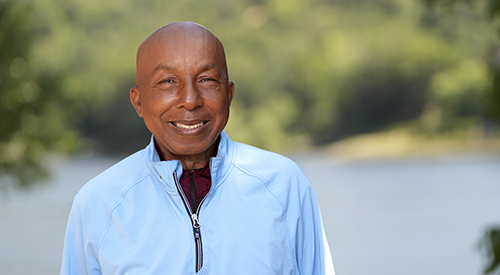
Veteran Vic Modesto, once homeless, now helping the homeless.
Vic was stoned and wandering for 18 years of good jobs, bad jobs, losing jobs and eventually homelessness and
heroin addiction.
Vic encountered a lot of the mental health problems that lead to homelessness. Married, then divorced, he
experienced the whole nine yards of street baggage that causes the hopelessness he admits he endured.
“I would get in rehab and then get out and start using and drinking again. I tried the VA but it was not a positive
experience back then. And then I found the Palo Alto VA Medical Center. Boy, had they changed.”
Dr. Keith Harris, who is the new VA National Director of Clinical Operations, Mental Health Homeless and
Residential Rehabilitation Treatment Programs, recognizes the social disconnect in homeless Veterans such as Vic.
He points out that “One of the most serious symptoms of homeless people is the lack of a sense of control. At Palo
Alto, we use a phrase to capture our approach to treatment: ‘I create what happens to me.’ We find that this
approach helps homeless people move away from a past-focused sense of victimhood to a more active, future-oriented
role in molding the conditions of their lives.
“The percentages of homeless Veterans with substance use or psychiatric issues is telling. In the most recent
annual report of the Health Care for Homeless Veterans program, which is VA’s outreach and case management program, it
reported that 64% had a diagnosis of drug or alcohol dependence.”
“Another 57% had a diagnosis of serious mental illness. Serious mental illness is defined as having a psychiatric
diagnosis that falls into one of the following categories: schizophrenia, other psychotic disorder, mood disorders and
PTSD.
“It’s also significant that 82% had a diagnosis of either drug or alcohol dependence or
serious mental illness.”
(These statistics vary depending on the program reports, as the programs
target different issues and acuity levels.)
Given the large majority of homeless Veterans with substance use or psychiatric issues, VA has placed a large
emphasis on treating these issues within its homeless programs. Veterans are treated within the homeless programs,
and/or referred to specialty care as needed. The majority of Veterans report significant improvement in these areas
upon leaving VA homeless programs.
Vic happily remembers Christmas time, 1998, when he finally decided, “I do have a choice. I can face the reasons I
am homeless, those reasons I was afraid to deal with. I went to the VA for detox, and I found out that people at the
VA were really interested in what happened to me.”
He now works for the VA in a California domiciliary program where he counsels homeless Veterans on how to get off
the street, face their problems and make those “scary” choices that open a positive door for their futures. “My dad
was a good soldier and my brother was a good sailor. I wasn’t. This is my opportunity to help out those good soldiers
who served their country and right now, could use a little help.”
Dr. Harris points out, “When you consider the causes of homelessness, in addition to lack of employment or income,
often times you find mental health issues and substance use issues or a combination of both. So in working to help
people find housing and jobs, programs to support mental health and substance use treatment work hand in hand.”
Vic says, “We have this saying here: The path is wide. Every Veteran is different. Their problems are different.
But the road to recovery is wide, with a lot of different ways to treat a lot of different problems.”
Getting the word out to homeless Veterans is always one of the VA’s top priorities, according to Dr. Harris: “We
have a National Call Center where homeless Vets can call for help: 877-424-3838. There is also a 24/7 online chat
site: Homeless Veterans Chat.
Dr. Keith Harris
“We are always trying to find those Veterans who need help. We distribute our contact information to shelters, soup
kitchens, libraries, primary care doctors and the outside community.
“I have wanted to do this work since I served my internship in the domiciliary program at the Palo Alto VA Medical
Center. I was deeply moved watching these homeless Veterans focus their considerable energy and skill on creating a
new life for themselves. Homelessness is a very complex problem but that’s what makes it so rewarding to work
with.”
Dr. Harris previously served as the Chief of the Domiciliary and Homeless Programs at the VA Palo Alto Health Care
System where Vic changed his life. He directed the full continuum of VA homeless programs and services at Palo Alto,
including several nationally-recognized programs. He is a long-time member of the Domiciliary Field Advisory Board
and has contributed to many VACO projects.
The Department of Veterans Affairs (VA) is taking decisive action to end Veteran homelessness in five years. All
Veterans at risk for homelessness or attempting to exit homelessness must have easy access to programs and services
including Prevention, Housing Support, Treatment, Employment and Job Training.
Help is here:Homeless Veterans Website
By Hans Petersen, VA Staff Writer